
The Quiet Power of Showing Up
There’s a particular kind of satisfaction that comes from work you didn’t have to do. Nobody requires you to spend a Saturday morning pulling weeds from a public stairway or hauling lumber for a bench that strangers will sit on. You do it anyway, and something in that choice matters more than the bench itself.
Service Is a Different Kind of Currency
We’re used to thinking about value in terms of money, time, or convenience. Personal service runs on a logic entirely different from that of business. When you volunteer, you’re not optimizing for return on investment; you’re investing in something that doesn’t pay you back directly, at least not in any way you can put in a bank account. And yet most people who do it consistently will tell you it’s one of the most reliably meaningful things in their lives.
That’s not a coincidence. Humans seem wired to find purpose in contributing. We don’t just want to consume a good life; we want to have built some part of it. A neighborhood, a friendship, an institution, a tradition. Service is one of the few activities where the value you create and the value you feel are nearly the same thing.
It Builds the Thing Markets and Governments Can’t
Roads get built by contracts. Laws get passed by legislatures. But trust, neighborliness, and the feeling that you belong somewhere, those get built by people doing small, voluntary things for each other, over and over, until a place starts to feel like home rather than just an address.
This is sometimes called social capital, and like financial capital, it can be spent down or built up. A community where everyone assumes someone else will fix the broken thing eventually has no broken things fixed. A community where people default to “I’ll handle it” accumulates something powerful: the quiet expectation that people here look out for each other. That expectation is worth more to a neighborhood’s quality of life than almost any amenity money can buy.
Service Changes the Server, Not Just the Served
There’s a reason volunteering is consistently linked to higher reported well-being, even among people who didn’t expect to feel anything from it. Acting generously tends to shift how you see yourself, from someone who receives a place, a community, or a life, to someone who actively shapes it. That shift is subtle, but it compounds. People who serve regularly tend to feel more rooted, less anonymous, and less like passive passengers in their own lives.
It also recalibrates the scale. Spend an afternoon doing something genuinely useful for someone else, and your own frustrations tend to shrink a little in proportion, not because they stopped mattering, but because you’ve just been reminded how much capacity you actually have to affect the world around you.
The Myth of the Big Gesture
We often imagine service as something dramatic, disaster relief, a founded nonprofit, or a heroic rescue. Those things matter, but they’re not the backbone of a functioning society. The backbone is smaller and far less photogenic: the neighbor who mows an elderly couple’s lawn, the volunteer who shows up to every cleanup, whether or not anyone’s watching, the person who simply does the unglamorous task that keeps a shared space dignified.
Personal service, at its core, isn’t about scale. It’s about reliability. A society doesn’t need everyone to be extraordinary; it needs enough people willing to be dependable.
Why It Matters Now
In an era where so much of life is mediated through screens, algorithms, and transactions, personal service is one of the few remaining acts that’s unmistakably human, unscripted, unmonetized, and unmistakably yours. It can’t be automated in any way that preserves its meaning. A robot can mow the lawn; it can’t make the gesture mean anything to the person living next door.
That’s the real argument for personal service: not that it fixes everything, but that it’s one of the last things that still requires you, your time, your hands, your willingness, and that, in giving them, you get something back that’s hard to find anywhere else.
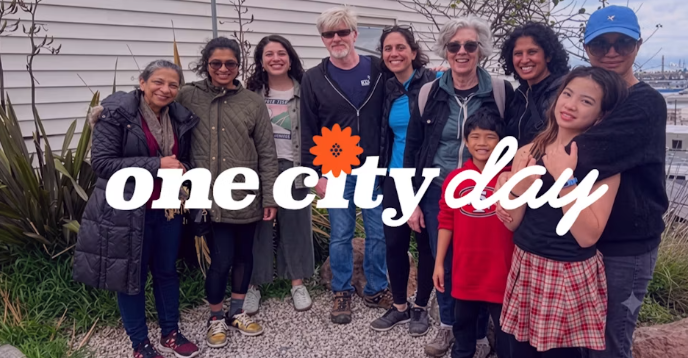
Bernal Heights, Let’s Show Up for One City Day – July 11th
There’s something different about a neighborhood that takes care of itself. You can feel it walking down a street where someone’s clearly been tending the planters, where the stairway mosaic still gleams, where the corner lot has a bench instead of a pile of trash. That’s not an accident, it’s the result of neighbors deciding, over and over, to spend a Saturday morning making their block a little better.
That’s exactly what One City Day, happening Saturday, July 11th, is all about. It’s a citywide day of hands-on volunteering, and right here in Bernal Heights, there are two great ways to get involved.
Earn Your Hot Dog
Look, we get it. One City Day just isn’t happening for you. Maybe you’re out of town, maybe you’ve got plans, maybe you have to wash your hair that day. We don’t judge. Mostly.
But before you write yourself off as a Bad Neighbor forever, we’ve got good news: there’s a workday on July 4th, and it comes with a built-in excuse to skip absolutely nothing else you had planned.
Here’s the move: roll up before the BBQs fire up, get your hands dirty for an hour or two, then go eat hot dogs with the unshakable confidence of someone who earned their holiday. You haven’t really celebrated independence until you’ve spent the morning fighting weeds for the public good; it’s basically the most American thing you can do, short of inventing a new condiment.
No fireworks-grade commitment required. Show up, do a little good, leave with dirt on your jeans and zero regrets. Your neighborhood will thank you. Your burger will taste better. Everybody wins.